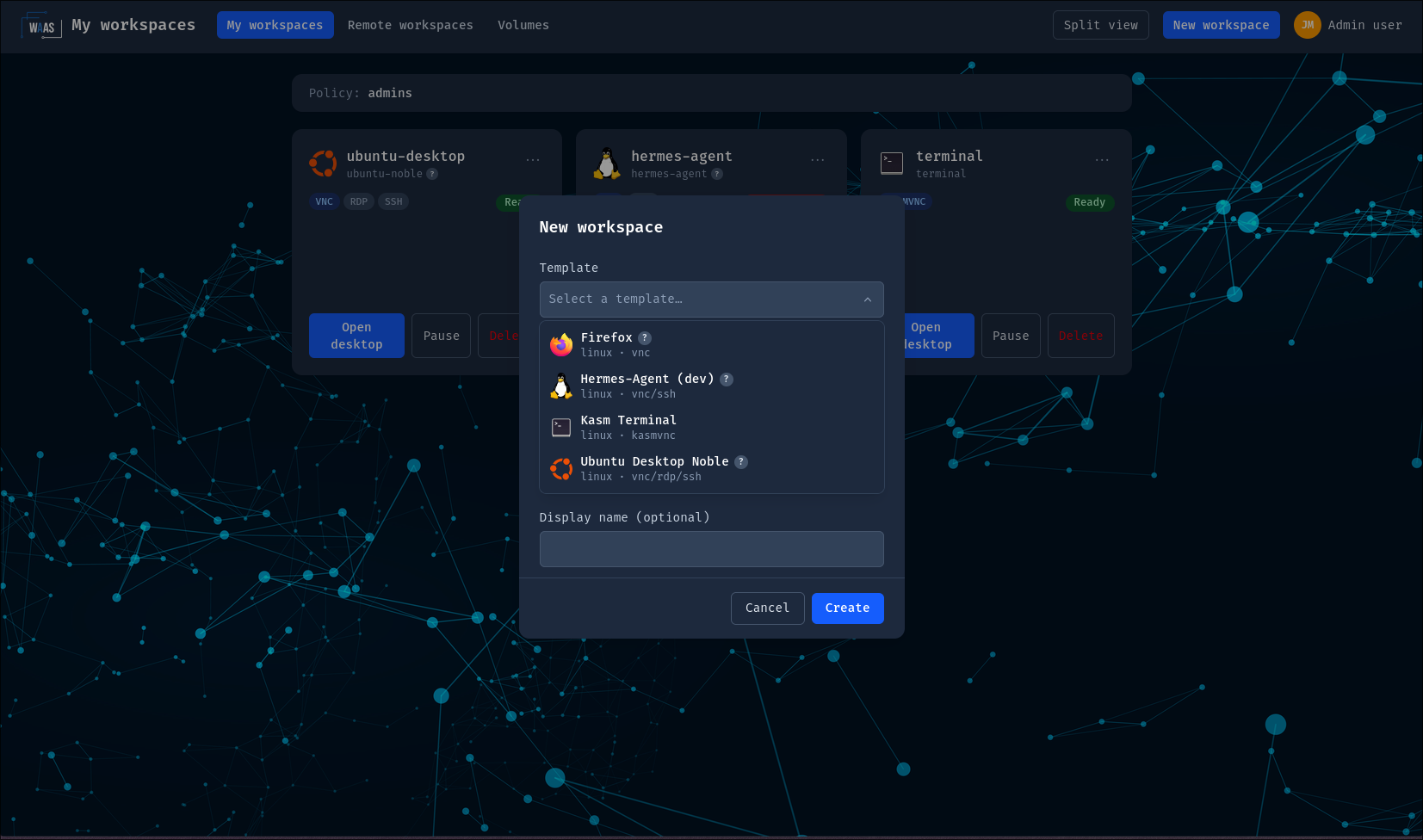
Templates and protocols
A WorkspaceTemplate is the
admin-authored shape of a desktop. This page covers its three big
levers: the workload, the protocols, and the overrides a
workspace creator may apply.
Workload
The template picks the workload kind and passes through the pod spec:
spec:
  workload:
    kind: Deployment # Deployment (default) | StatefulSet | Pod
    securityContext: {} # container-level
    podSecurityContext: {} # pod-level
    volumes: []
    volumeMounts: []
    nodeSelector: {}
    tolerations: []
    serviceAccountName: ""
- Deployment (default): 1 replica,
Recreatestrategy — the home PVC is RWO, two desktop pods must never overlap. - StatefulSet: stable identity.
- Pod: legacy bare-pod behavior.
The home PVC mount, protocol ports and probes stay platform-managed and cannot be overridden. Changing a template's workload kind never touches running workspaces — the new kind applies at the next provisioning.
Protocols
A template may declare several connection protocols:
spec:
  protocols:
    - name: vnc # vnc | rdp | ssh | kasmvnc
      port: 5901
      default: true # first entry wins if none is marked
      params: # locked guacd connection parameters
        color-depth: "24"
      userParams: [color-depth, cursor] # user-tunable at connect time
      credentialsSecretRef: my-creds # optional explicit credentials
vnc,rdpandsshare freely combinable on one template.kasmvncis exclusive: it bypasses guacd entirely, so a template declaring it may declare no other protocol.
The kasmvnc protocol is at an experimental stage. It may change
incompatibly or be removed at any time, without a deprecation
cycle. Don't build production templates on it — prefer vnc, rdp or
ssh.
- With no
protocolsat all, one is synthesized fromos/port(linux →vnc:5901, windows →rdp:3389). - Every
paramskey is validated at admission against the platform's parameter registry: unknown names and platform-owned parameters (credentials, gateways,enable-sftp, recording, …) are rejected for every caller, kubectl included. - The workspace Service exposes every declared port;
status.protocolslists them with the effective default. At connect time users pick a protocol among the declared ones and may tune the parameter names delegated byuserParams(entries are exact names or whole categories likecat:audio).
Which protocol should a Linux template use?
VNC is the recommended protocol for Linux desktops built from waas-images; RDP is a compatibility bridge and SSH gives a terminal (guacd renders it — nothing to install client-side). See the protocol capability matrix below.
Credentials
Desktop credentials never live in a CR. Three levels, in precedence order:
credentialsSecretRef— explicit, always wins. Each protocol entry may name a Secret with the keysusername,password,private-key,passphrase(all optional). The api-server resolves it server-side when a session starts — the browser never sees the values. Ship it with External Secrets/Vault; typically the same Secret also feeds the pod via envvalueFrom(e.g.WAAS_DESKTOP_PASSWORD) so both sides agree. EnvvalueFromis a template-side channel — workspace overrides only ever carry literal values (see Creator overrides).- Generated per-workspace credentials — the default when nothing
explicit is provided: the operator generates a random credential per
workspace, stores it in a Secret next to the CR, wires it into the
pod, and the api-server resolves the same Secret at connect time.
Zero template configuration. For
ssh, this generates a keypair: public key mounted into the pod, private key handed to guacd at connect — the private key never exists in the pod's namespace. - Literal
WAAS_DESKTOP_PASSWORDwithdocker run— the standalone path for running a waas-images build outside the platform. Literal env passwords in a template are not read by the platform.
Rotation of generated credentials is create-only: delete the Secret and roll the workload; the operator never rotates on its own.
SSH specifics
SSH is a capability of the OS-only waas-images desktops
(ubuntu-desktop-noble, debian-desktop-13, fedora-desktop-43) —
never of the per-app images, which are VNC-only by construction. The
in-image sshd runs fully unprivileged on port 2222 and is
publickey-only: password auth is impossible by construction.
Declaring the ssh protocol on a template is enough — the operator
generates the keypair and enables sshd itself.
Creator overrides
The template decides what workspace creators may deviate:
spec:
  overrides:
    allowedFields:
      [
        env,
        resources,
        protocol,
        protocolParams,
        securityContext,
        podSecurityContext,
        volumes,
        nodeSelector,
        tolerations,
        schedule,
        placement,
        metadata,
      ]
    owner: alice # this platform user may override anything (template-side)
Merge semantics: env/volumes/mounts merge by name (workspace wins),
nodeSelector merges key-wise, tolerations append, security contexts
replace. Metadata (labels/annotations) merges under the
template's workload metadata — platform and template keys always win,
reserved domains are rejected. A schedule override replaces the
template's schedule wholesale.
On top of the template's list, the user's policy may restrict further — the effective allow-list is the intersection of both. Enforcement is server-side (admission webhook + a reconciler re-check), and every applied override is audited (field and env var names, never values).
An override env entry may set only a literal value. valueFrom
sources — secretKeyRef, configMapKeyRef, fieldRef,
resourceFieldRef — are rejected in a workspace override (by the
same admission webhook that enforces the allow-list, and stripped again
by the operator when the workload is rendered). Wiring a Secret into a
desktop is a template decision: the admin who authors the template
references it through env valueFrom or
credentialsSecretRef, both resolved against the
workspace's own namespace. Through env, therefore, a workspace creator
tunes values and never references Secrets.
This holds for env only. A delegated volumes override reaches
Secrets directly, by mounting them — see what delegating that right
grants.
Allow-listing volumes lets users mount arbitrary volume sources —
including hostPath. Only enable it on templates aimed at trusted
groups.
In the portal, users who hold override rights see an Advanced (template overrides) panel in the creation dialog; everyone else never sees it. The panel mirrors the webhook's decision — it never replaces it. Part of the set is also editable after creation, from the workspace's settings tab: env, nodeSelector, tolerations, resources, metadata and schedule (applied by rollout — clearing one falls back to the template). Security contexts and volumes stay creation-time-only — see Accepted limitations.
Protocol × feature matrix
| Feature | VNC | RDP | SSH | KasmVNC (experimental) |
|---|---|---|---|---|
| Audio playback | ✅ (enable-audio + exposeAudioPort) | ⚙️ param exists; official images ship no RDP audio chain | N/A | ❌ |
| Governed clipboard | ✅ live | ✅ live, text only | ✅ live | ✅ container-side |
| Persistent home | ✅ | ✅ | ✅ | ✅ |
| File transfer | 🚫 platform-blocked | 🚫 | 🚫 | 🚫 |
| Session recording | 🚫 platform-blocked | 🚫 | 🚫 | ❌ |
| Keyboard layout | N/A (direct keysyms) | ✅ auto-detected from the browser locale | N/A | N/A |
| Dynamic resize | ✅ | ✅ | ❌ (CSS-scaled) | ✅ native |
Legend: ✅ supported · ⚙️ advanced/YAML only · 🚫 deliberately blocked for everyone (until the feature ships with its own policy gate) · ❌ absent · N/A not applicable.
Server-side audio needs two things: the enable-audio session
parameter and exposeAudioPort: true on the vnc protocol entry —
that opens PulseAudio's port 4713 on the container and Service
(cluster-internal only). Without the port, sessions degrade silently:
video OK, no sound.
Portal comfort features
Shipped alongside templates and worth knowing about: split view (1–3 desktops side by side with draggable dividers), folders to group workspaces, per-user protocol/parameter preferences (re-validated server-side at every connect), and light/dark theme.