Volumes
Every workspace gets a home volume — a PVC mounted at the desktop
user's home directory (default /home/waas_user, configurable per
template via spec.homeMountPath). It is the only thing that survives
pod restarts, pauses, image changes… and, by default, workspace
deletion.
That "only" is load-bearing: a package installed with apt goes to the
container layer and is gone on the next restart. The waas-images
desktops ship mise for exactly this reason — it installs runtimes
and CLI tools under ~/.local/share/mise, on the volume, so they
persist with the rest of the home (see
Workspace images).
Retention model
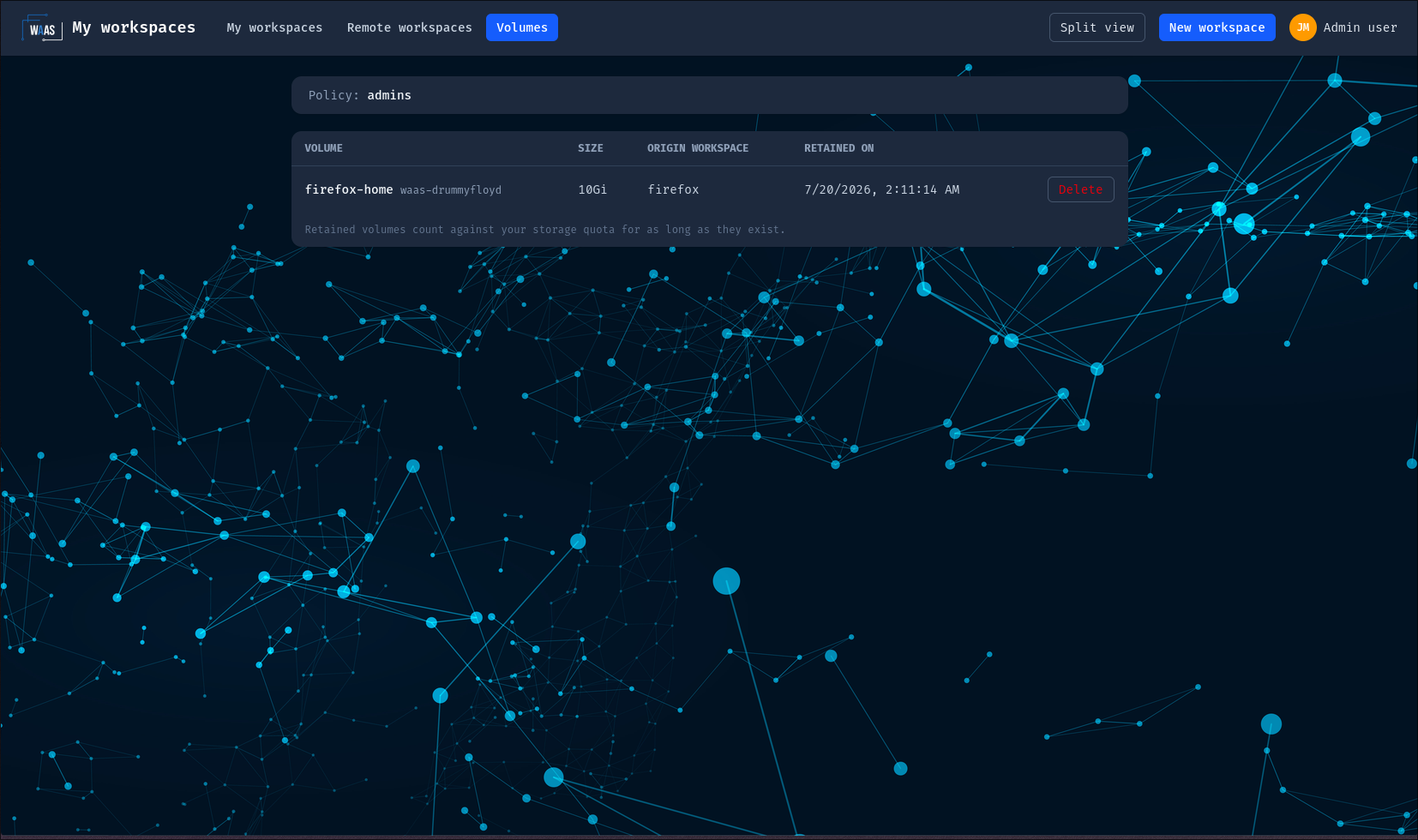
The PVC is the source of truth — no separate database of volumes. A
retained volume is a WaaS-managed home PVC whose workspace no
longer exists, identified by its labels (owner, retained=true,
provenance annotations).
creation ──► home PVC "<workload>-home"
   │
workspace deletion
   │
   ├── keep volume (DEFAULT) ── the PVC is DETACHED, not deleted
   │     still yours, still counted against your storage quota
   │     │
   │     ├── reuse: create a new workspace "from an existing volume"
   │     │     (same owner, same target namespace — a PVC is namespaced)
   │     │
   │     └── delete it later: portal Volumes tab (or admin Fleet → Volumes)
   │
   └── delete volume (EXPLICIT opt-in in the deletion dialog)
         the PVC is deleted along with the workspace
Two deliberate consequences:
- GitOps can never destroy user data:
kubectl delete/ ArgoCD prune never carry the opt-in, so they always retain the volume. - A policy TTL deletes the volume:
lifecycle.maxLifetimedeletes the workspace and its home on expiry — reclaiming storage is precisely what a TTL is for.
Reusing a volume
At creation, pass the retained volume's name:
spec:
  templateRef: ubuntu-desktop
  homeVolumeName: my-old-workspace-home # "start from an existing volume"
The webhook checks: same owner, volume actually retained, same target namespace. The operator then re-labels the volume as live.
"Same target namespace" is a hard constraint — a PVC is only attachable
where it lives. Volumes retained under a previous pattern (e.g. the
shared waas-workspaces, the built-in default before chart 0.3.0) do
not appear when the new workspace resolves to waas-<user>. Moving
them is a storage operation: see the migration
note.
Template metadata on home volumes
A template can stamp labels and annotations on the home PVC via
spec.homeVolume. The driving use case is storage machinery driven by
PVC labels — e.g. enrolling every home into Longhorn recurring backup
jobs:
spec:
  homeVolume:
    labels:
      recurring-job.longhorn.io/source: enabled
      recurring-job-group.longhorn.io/backup-daily: enabled
Size, class and mount path stay where they were — the top-level
homeSize, storageClassName and homeMountPath.
The sync model is deliberately different from the other metadata surfaces (namespace metadata is create-only, workload metadata converges by rollout): homeVolume metadata is synced in place on every reconcile. Editing the template enrolls volumes provisioned long ago without touching the workspaces — and since PVC metadata sits outside the pod-template fingerprint, enabling a backup never restarts a desktop.
Removals propagate too. The operator records the keys it stamped in a
ledger annotation on the PVC (waas.xorhub.io/template-meta); a key
dropped from the template is removed at the next reconcile, while keys
an admin set on the PVC by hand are never in the ledger and never
touched. The usual reserved-domain denylist applies (kubernetes.io,
xorhub.io, argoproj.io, service-mesh injectors, … — longhorn.io
is deliberately allowed) and operator-owned labels always win.
Retained volumes keep their metadata and ledger — a detached volume still holds the user's data, exactly the one worth keeping in the backup rotation. It is not re-synced while detached (no workspace reconciles it); the next adoption converges it against the adopting template, removing the old template's ledgered keys and stamping the new ones.
This surface is admin-only by design: there is no overridable field for it, because PVC labels drive platform machinery (backup, DR), not user preference.
Quotas
Retained volumes count against the policy's aggregate storage quota
exactly as attached ones do (never against maxWorkspaces or compute).
The portal home page shows used / limit with a "of which X retained"
breakdown. A volume adopted at creation counts at its actual size,
not the template's homeSize.